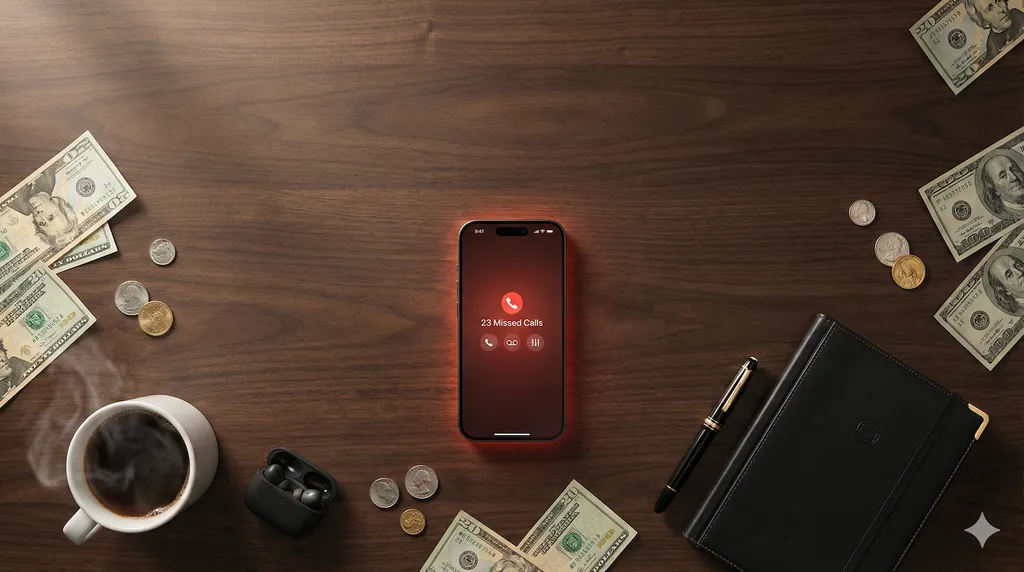
Voicemail is Dead (And It Took Your Revenue With It)
80% of callers won't leave a message. 85% won't call back. Every missed call is money walking straight to your competitor. Here's the math you can't ignore.
Let me ask you something. How much money did you lose last week?
Not in bad investments. Not in overhead. In missed phone calls that went to voicemail.
You don't know, do you? And that's the problem.
Here's what I know: 80% of callers who reach your voicemail won't leave a message. They hang up. They call your competitor. They spend their money somewhere else.
And you? You're sitting there wondering why business is slow.
The Math You Can't Afford to Ignore
The average business loses $126,360 annually from unanswered calls. That's not a typo. Six figures. Gone.
Small businesses? You're not off the hook. If you're missing around six calls per day, you're hemorrhaging $26,000+ every year.
But let's get specific. Let's talk about your industry.
If you're running a plumbing or HVAC business, the average service call is worth $400-$460. Miss six calls a day? That's $2,400 in potential revenue. Daily. Multiply that by 365 days and you're looking at $876,000 in potential annual revenue that's evaporating because you can't pick up the phone.
Each missed call costs between $12 and $1,200 depending on what you sell. Home service companies? That number skews toward the high end. $1,200 per missed call.
This is what I call stepping over dollars to pick up nickels. You're worried about saving $50 on office supplies while a quarter-million in revenue walks out the door.
What Customers Actually Do When You Don't Answer
Here's the brutal truth: 85% of callers won't call back if you don't answer.
80% will call your competitor instead. Not tomorrow. Not later. Immediately.
I've seen the forum complaints. Real people. Real frustration.
"Left three voicemails, gave up and called someone else."
"If you can't answer during an emergency, you're not an emergency service."
"First company to answer got my $500 job."
You know what's happening? In the time it takes your phone to ring four times and roll to voicemail, your customer is already dialing the next plumber on Google. The first one to answer wins. Period.
And here's the kicker: 67% of customers hang up in frustration when they can't reach a live person. They're not mad at their problem anymore. They're mad at you.
When hot, they go cold. That's the rule. A customer calling you right now has a problem that needs solving right now. They're motivated. They're ready to spend money. They're a hot lead.
Leave them waiting? They cool off. They procrastinate. They call someone else. They forget about it entirely.
You get one shot. Miss it, and you're done.
Welcome to Instant World
We live in Amazon same-day delivery world. Alexa answers questions instantly. ChatGPT writes essays in seconds.
And you think customers will wait for you to check voicemail?
Get real.
90% of consumers expect an immediate response. And when they say "immediate," they mean it. 60% define immediate as within 10 minutes. Not tomorrow morning. Not after lunch. Ten. Minutes.
Here's the part that should terrify you: Phone calls convert at 30-50% for sales leads. You know what voicemail converts at? 4.8%.
Let that sink in. A live conversation closes the deal 30-50% of the time. Voicemail? Less than 5%.
You're trading a 50% chance at a sale for a 5% chance. That's not a business strategy. That's business suicide.
Real example: Arctic Bear Plumbing went from $180 average tickets to $400 by improving how they engaged customers. That's a 122% increase. More than doubled. How? By actually talking to customers when they called.
Another one: A law firm implemented an AI receptionist. 1,775% ROI. They saved $45,000 in labor costs annually while capturing more leads.
A medical practice? 60% increase in new patient intakes, translating to $1.7 million in additional revenue.
These aren't unicorns. These are businesses that stopped treating phone calls like an afterthought.
The Fix Isn't Working Harder. It's Working Smarter.
You can't answer every call yourself. You're running a business, not sitting by the phone.
But here's what you can do: systemize it.
Traditional receptionist? $40,000+ per year in salary and benefits. And they can't work 24/7.
Modern answering service? $200-$400 per month. AI receptionist? $49-$199 per month.
You do the math.
Companies that implement instant response solutions see results within 6-12 months. One staffing company reduced turnover by 24% and saved $3.2 million annually just by answering scheduling calls faster.
Vendasta's AI receptionist captured 700+ qualified leads in four months with a 76% conversion rate. Not by working harder. By responding instantly.
The technology exists. It works. It's affordable.
The question isn't whether you can afford it. The question is whether you can afford NOT to have it.
Stop the Bleeding
Every call that goes to voicemail is money leaving your business. Every unreturned voicemail is a customer you'll never see again.
You wouldn't leave cash sitting on the counter for customers to steal. But that's exactly what you're doing when you rely on voicemail.
The market has moved. Customer expectations have shifted. The businesses winning right now are the ones answering their phones instantly-even when they're elbow-deep in another job.
You can keep defending voicemail. Or you can defend your revenue.
Get Started for Free and see how many calls you're actually missing. Or Schedule a Personal Demo and let us show you exactly what instant response can do for your bottom line.
The choice is yours. But your customers? They won't wait around for you to make it.
Ready to Never Miss Another Call?
Start your free trial with Julya AI and turn every ring into revenue.
Get Started for FreeRelated Articles

The 3 AM Test: How to Book Appointments While You Sleep (Without Waking Up)
40% of appointments happen after hours. Miss those calls and you're leaving $126K on the table. Here's how to capture every lead-even at 3 AM.

The Warm Handoff: Why AI Should Brief Your Staff, Not Replace Them
Smart businesses use AI to multiply human effectiveness, not eliminate it. Here's why the warm handoff beats full automation every time.
From Chaos to Calendar: Stopping the Double-Booked Disaster Before It Happens
Double-booking costs businesses $26,000 yearly. Here's how smart scheduling prevents conflicts, saves revenue, and stops customers from rage-quitting.